Structural Drying in Miami Beach, FL
Humid island air slows drying, and concrete and terrazzo hold water longer than most materials. The drying team sizes the equipment to the loss and keeps it running until the readings say dry.
(888) 621-2041Put the drying equipment to work in Miami Beach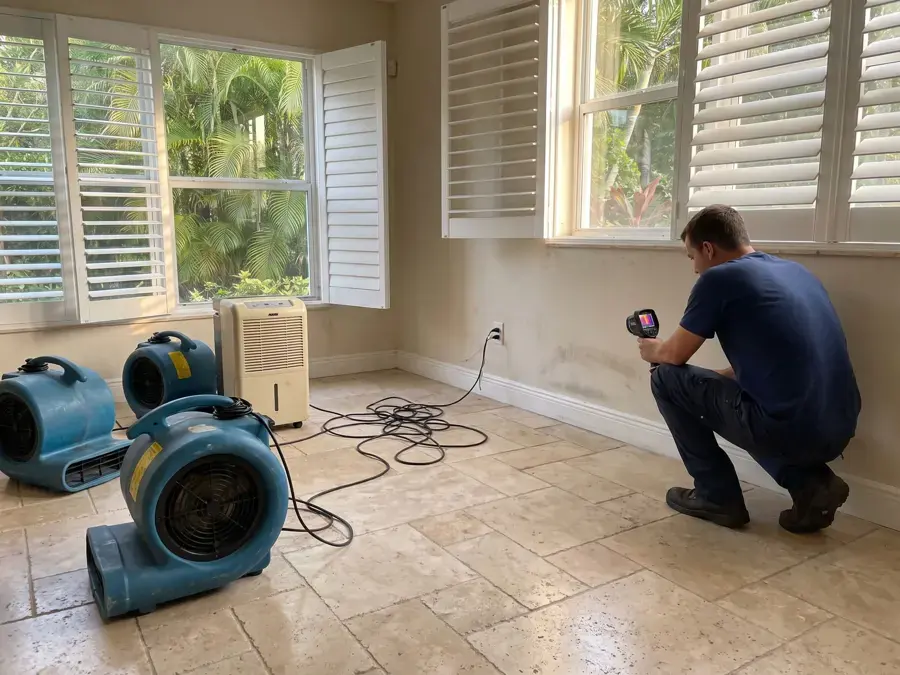
What to do the moment you find wet walls and floors
- 1
Stop the water first
Drying cannot start until the source is shut off or repaired.
- 2
Remove standing water
Extraction always comes before air movers and dehumidifiers.
- 3
Keep the AC running
If it is safe and the area is not contaminated, the AC helps pull humidity down.
- 4
Leave equipment on
Do not turn off or move air movers and dehumidifiers; they are sized to the room.
- 5
Keep the readings
Ask for the daily moisture logs for your claim file.
What does structural drying cost in Miami Beach, FL?
In Miami Beach, FL, structural drying typically runs $1,500 to $15,000 or more. The drivers are the class of loss, the square footage, dense materials like concrete, terrazzo and hardwood, and how many days the equipment has to run.
One room, Class 1 or 2
- Air movers and one LGR unit
- Three to five days
- Daily readings
Full unit, Class 3
- Wall and ceiling cavity drying
- Several dehumidifiers
- Psychrometric logs
Concrete or terrazzo, Class 4
- Desiccant dehumidification
- Floor mats and slab drying
- Extended monitoring
For a planning range on your own loss, try the Miami Beach water damage cost calculator. The restoration contractor who responds sets the real scope after the moisture map.
How structural drying is handled in Miami Beach
- 1
Moisture mapping
The tech who does the walkthrough maps wet materials with pinless meters and a thermal camera before any equipment goes down, including the unit below and the wall cavities.
- 2
Extraction
The extraction crew pulls standing water with truck-mounted or portable units, so it leaves the building instead of spreading along the slab.
- 3
Air movers and LGR dehumidifiers
The drying team sets air movers to each room's evaporation load and runs LGR dehumidifiers, adding desiccants for dense Class 4 materials like concrete and terrazzo.
- 4
Daily readings to the drying goal
Readings are logged every day, and equipment comes out when wet materials sit within 2 to 4 points of a dry reference in the same building.
Structural drying is the part of a water loss you cannot see, and the part that decides whether mold, odor and swelling show up weeks later. It means drying the materials inside the building, not just the surfaces, and proving it with readings.
Why drying is harder on Miami Beach
Outdoor air here is warm and humid most of the year, so opening windows rarely helps a wet room dry. Many buildings sit on concrete slabs with tile or terrazzo on top, and concrete gives up water slowly. Older plaster walls in Art Deco and MiMo buildings hold moisture differently from modern drywall. All of that changes how much equipment a loss needs.
- LGR (low grain refrigerant) dehumidifiers pull water out of humid air efficiently.
- Desiccant dehumidifiers handle dense Class 4 materials like concrete, terrazzo and hardwood.
- Air movers are set to each room's evaporation load, not placed at random.
- Floor mats and cavity drying systems push dry air into hardwood and wall cavities.
Class 1 through 4 and what it means
IICRC S500 sorts losses by how much water the materials absorbed and how hard they are to dry. Class 1 is a small area with low-porosity materials; Class 3 means walls and ceilings soaked from above; Class 4 is dense material like concrete, stone and hardwood that needs special drying. The class sets how many air movers and dehumidifiers go in each room.
Equipment leaves on readings, not on a schedule. The drying team compares wet materials to a dry reference in an unaffected part of the same building and pulls equipment when they land within 2 to 4 points.
Logs for the claim file
Every day, the drying team records moisture content in the materials and temperature and humidity in the air (psychrometric readings). Those logs, the moisture map and the photos show the adjuster why each piece of equipment was there. The EPA moisture and mold guidance explains why drying within 24 to 48 hours matters, and UF/IFAS Extension publishes guidance on humidity in South Florida homes. The drying time estimator gives a quick read on your own loss.
Related: water extraction, condo leaks and commercial drying. For a planning number, try the water damage cost calculator.
Related water damage services in Miami Beach
Water damage restoration across Miami Beach and the nearby islands
The Miami Beach restoration crew covers South Beach, Mid-Beach and North Beach, plus Surfside, Bal Harbour, Bay Harbor Islands, North Bay Village and Fisher Island.
From South of Fifth to the Normandy Isles, the restoration team works 24/7 in every Miami Beach ZIP: 33139, 33140, 33141, 33109, 33119 and 33239, plus 33154 to the north.
High-rise access, loading docks and building management rules are part of the job on the island, and the crew plans for them before the equipment goes up.
See every neighborhood and ZIP coveredStructural Drying questions in Miami Beach, FL
What is structural drying?
It is drying the building materials themselves, like drywall, framing, subfloor, concrete and cabinets, not just the visible surfaces, and confirming it with moisture readings.
How long does structural drying take?
A contained Class 1 or 2 loss usually dries in three to five days. Concrete, terrazzo, hardwood and plaster take longer.
Why not just open the windows?
Miami Beach outdoor air is usually humid, so it can add moisture instead of removing it. Dehumidifiers and controlled air movement dry faster.
What is the difference between LGR and desiccant dehumidifiers?
LGR units cool air to condense water and work well in most losses. Desiccant units absorb moisture chemically and work better on dense materials and in cooler, drier conditions.
How do crews know when it is dry?
They compare readings in the wet materials to a dry reference in the same building. When the wet materials land within 2 to 4 points, equipment comes out.
Is the equipment loud?
Air movers and dehumidifiers make steady noise and run day and night. Crews place them to dry the loss efficiently and can adjust placement for sleeping areas when possible.
Structural Drying in Miami Beach? Call now.
Every hour water sits, it moves deeper into drywall, cabinets, baseboards and the slab. The Miami Beach restoration crew extracts, dries to the S500 goal and documents the loss for your claim.
(888) 621-2041Speak with Miami Beach 24/7 dispatch